
Peasants to Puddles
My Family History - By Nicky Rowberry
John Archibald - Private 5224
This page is dedicated to the memory of John Archibald who died on 11th April 1917.
John Archibald died on 11th April 1917 in France. He was unfortunately one of the casualties amongst the millions of men who lost their lives in World War 1. It seemed sad for him to have died and all but these bare facts remembered, so I've tried to find out at least a little about his life before his untimely death aged just 18.
John Archibald was born on 3rd August 1898 at Bonville Lodge in Maryhill, Glasgow in Scotland. He was the 5th of 7 known children of George Archibald and his wife Elizabeth (nee Sommerville). His father George was a gardener. In 1901 the family were living at Acre Road in Maryhill; 5 children were at home at this point with a further 2 children being born in the next couple of years.
Sadly John's mother Elizabeth died in 1909, aged just 46. George was left with 7 children to look after, although by then the older ones were able to work to help support the family. By 1911 the family were living 1184, Springburn Road, Maryhill. This was likely a block of tenement flats as there were multiple families recorded at the same address. 6 of the 7 children were still at home and George also had his mother-in-law Marion Sommerville and her daughter Ann to help look after the younger children. John, aged 12 was still at school. Not long after the census was taken, the widowed George married Janet McGregor, an unmarried cook from Maryhill.
In the summer of 1911, George with his new wife and 6 of his children, (John Archibald included) set sail for Brisbane, Australia on the SS Moravian. Theirs was an "assisted passage", the governments of the time being keen for people to move to Australia. John's oldest brother George didn't travel with the rest of the family, but did also settle in Australia.
War broke out in the summer of 1914, when John would have been about 16 years old, in theory too young to enlist. But by the end of 1915, he had enlisted, aged just 17, although he claimed to be 18. The Commonwealth War Graves Commission website confirms that he was a Private in the 47th Battalion of the Australian Infantry and that his service number was 5224. I can't reproduce his CWGC record, but to see his page please click here.
Fortunately the Australian service records from WW1 have survived and are now available online. They show that John enlisted on 21st December 1915. He claimed to be 18 years and 4 months old, when in fact he was 17 years and 4 months. At the time of his attestation, he was working as a farm hand and living in Rosemount Street, Windsor, Queensland. Initially he joined the Reserve company of the 16/15 Battalion, but by May 1916, he had joined the 47th Battalion. He left Sydney on the HMAT Star of Victoria and was sent initially to Tel-el-Kebir, a military camp in Egypt but by June 1916, he had arrived at Marseilles in France on board the troopship HMT Huntspill. His service records state his character as "good".
His service records also state that John would have been entitled to the British War Medal and the Victory Medal as he served in an operational theatre of war. His father would also have received a Memorial scroll and plaque for his son.
You can now look online at the War Diaries for a given Regiment. War Diaries were kept as a daily record of operations, intelligence reports and anything else that was going on for a given battalion. So I've downloaded the War Diary for the 47th Battalion of the Australian Imperial Force. The battalion started April 1917 in Agenvillers in the Somme area of France. From there they went to Abbeville then Albert. In the days before John's death, the battalion had to endure heavy snowstorms, which can only have made things even more miserable. I've transcribed the relevant day (11th April) of John's death below.| 47th Battalion WAR DIARY FOR April - 1917 | |||
| WAR DIARY or INTELLIGENCE SUMMARY | |||
| Place | Date | Hour | Summary of Events and Information |
| BIEFVILLERS | April 11th | 3am | At 3am. Further orders were then read that 2 Companies were to be placed at disposal of CO 46 Bn for the assault. A Coy under Capt F.R.North Strength 160 + 3 officers (Lt JH HONEYSETT, 2/Lt RM. ARMITAGE + Lt FF CAMPBELL) and B Coy under Capt JN MILLER (3 off & 65 O/R) were detailed & moved into position at 3.45 am. C & D Coys under LIEUT CE YOUNG & CAPT FL DAVY remaining in SUNKEN ROAD. C 9 Central in support. A proportion amounting to 33% of strength 2 officers and men, so selected that were the whole battalion in action to be lost, there would still remain in this 33% a skeleton of every section platoon & company in the Battalion ready to carry on. |
| NOREVIL BULLECOURT | April 11th | 4am | These reserves were toegther with Cookers in VALLEY. C015B near NOREVIL all under LIEUT GNM GOODE. 2 Mills Grenades per man were issued to all ranks and parties were employed detonating further reserves in SUNKEN RD CG Central. A wise precaution as it turned out. (2LT M PRIOR DSO reported for duty from hospital & was attached to A Coy). The attack was entrusted to 48 Bn on left & 46th on right with 4th Bde AIF on their right & tanks were to have advanced against the immensely strong wire of the Hindenburg Line, but in my opinion they failed on a/c of their slowness, 7 being knocked out by direct hits before line was neared. |
| 5am | The other 3 wandering about having apparently lost direction. The 1st objective, the German front line was taken by 46th Bn without any artillery at about 5.30 and the 48 Bn proceeded with great gallantry & dash to, & captured the German Support line, the 2nd objective and held it. The 4th Bde doing the same on right, but on BOLLECOURT side no movement of troops was visible at all. | ||
| 10am | A solitary tank was seen entering BULLECOURT, crossing trenches & smashing down walls in approved style, but did not reappear - its crew walked out unharmed. At this time a squadron of Cavalry went out, but came back on foot. | ||
| BULLECOURT | April 11th | 12 | A call for reinforcements was made & D Coy under CAPT FL DAVY & 3 officers & 187 men were sent to reinforce - advancing under heavy fire over the open in artillery formation without losing a man - a very neat piece of work. They arrived & reported to Col R.L. LEANE DSO mc CO 48 Bn & placed themselves under his orders. The majority of C Coy with exception of Coy HQtrs were employed for some hours carrying to front line & bringing back wounded and worked unceasingly all day. |
| 12.30 | A heavy German counter attack developed at this time & was successful in ousting our men from the newly captured positions and on seeing this I dispatched 136 men all there were available, under 2/Lt AV PATERSON 2/Lt GV OCONNOR to reinforce, thus making the whole of the Battalion in action. This batch reported to LtCol DENHAM CO 46 Bn AIF and reinforced his line until relieved. | ||
| BULLECOURT | April 11th | 12.30pm | The whole battle was visible fro Bn HQ and as our troops retired to their original position, NOREVIL and Bn HQ were heavily shelled with HE, gas & lachrym |
| 4pm | The Hun had regained his positions now and we received orders that the Brigade was to be relieved and 47 Bn were to proceed on relief at 9pm to H20 where bivouacs were ready. Another blizzard came up at this time & continued for some time obscuring everything. As a number of wounded were still lying on Hun wire and in NO MANS LAND and majority of stretcher bearers, who had been working at high pressure all day, were exhausted, a party of 40 men from C Coy who had also been working now for 36 hours volunteered to remain and assist. They were the means of bringing & saving the lives of a number who lying wounded in the snow, would most probably have perished from exposure. | ||
| 10pm | As up to this time leading lines had on a/c of snow & wind only reached VRAUCOURT, so it was decided to halt for the night, pick up packs which had been left on Sugar mill & proceed to H20 Central in the morning. This was a wise move. | ||
| VRAUCOURT | April 12th | 9 11am 8pm | The field at H20 near SAPIGNIES was absolutely devoid of shelter & 6" of snow was on ground. Arrived on ground, collected transport and read orders to entrain at BAPAUME for FRICOURT. X25C32. Transport going by road. Entrained after waiting in rain since 2pm. Limited accomodation only allowing room for 60 on truck, standing and as men were still wet since morning of 10th, consequences were feared. |
| FRICOURT | April 13th | 7.30 11am | Arrived ALBERT and proceeded to CRUCIFIX Camp at FRICOURT arriving in good order. Casualties suffered during Engagement were 2 officers killed 2/Lt R. ARMITAGE, 2Lt CB KELLY (Sgt D.C. NICHOLSON who had been recommended for a commission) and 19 other ranks. 3 officers wounded CAPT F.R.NORTH, LIEUT J.H.HONEYSETT and 2/Lieut M.PRIOR DSO and 68 other ranks + 56 O/R missing. |
Sadly although the war diary names officers who were killed or wounded, it doesn't do so for the other ranks. So John was presumably one of the 19 Other Ranks listed as killed that day. The events described above were part of the First Battle of Bullecourt, a notorious offensive for Australian soldiers.
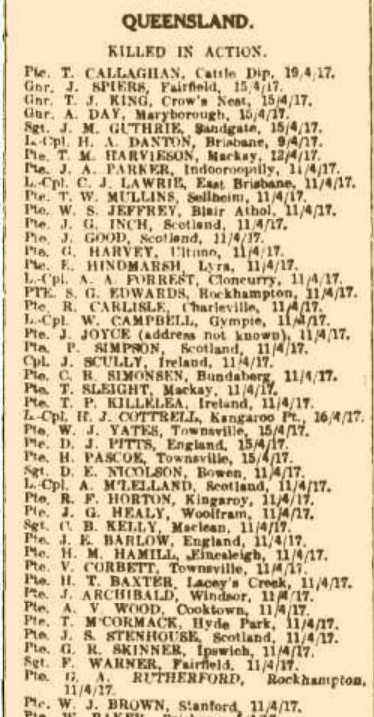
John's death was reported in the local newspapers. Sadly I've not been able to find a detailed write up of his death, just his name amongst lists of casualties. The image below is taken from the Brisbane Daily Mail on 10th May 1917. John is listed near the bottom of the image.
John was buried at the Queant Road Cemetery, in Buissy, France. He is also listed on Windsor's War Memorial in Australia.
So far I don't have a photograph of John. He came from a large family, so hopefully there are some relatives out there still. It would be lovely to be able to add a picture to complete his story, so if anyone has a photo of John Archibald, please do get in touch. E-mail: n.rowberry@btinternet.com
In researching John's life, several sites have been invaluable, so I've included links to some of them here.
The Commonwealth War Graves Commission:

The National Archives at Kew:

The British Newspaper Archive:

The Australian War Memorial website gives lots of information on Australian soldiers who died in WW1 (and other conflicts).

The National Library of Australia is a fantastic online resource for, amongst other things, digitised newspapers and images. 



If any of the above is of further interest, please feel free to contact me at: n.rowberry@btinternet.com
Nicky Rowberry 2026
Thank you for visiting my site. You are visitor number:
Peasants to Puddles - My Family History. By Nicky Rowberry