
Peasants to Puddles
My Family History - By Nicky Rowberry
George Wall - Corporal 1076
This page is dedicated to the memory of George Wall who died on 28th April 1915 in France.
George Wall died on 28th April 1915 in France. He was unfortunately one of the casualties amongst the millions of men who lost their lives in World War 1. It seemed sad for him to have died and all but these bare facts remembered, so I've tried to find out at least a little about his life before his untimely death aged just 39.
George Wall was born on 28th May 1876 at Westfields in Holmer, Herefordshire. He was the 7th of 8 children to John Wall and his wife Eliza Powell. His father John was a stone mason/bricklayer. His mother was described on the 1871 census as "bricklayer's wife" but really her occupation must have been a full time mother raising so many children. Sadly George's mother died in 1880, when George was only 4. In 1881 the family were still living in Westfield, the widowed John with 7 children - George Wall had started school. That same year the family must have moved to Llanelly in Breconshire, Wales as in August 1881 the widowed John Wall married again, his new wife being Emily Preece (nee Bowcott), also a widow.
Hopefully George's relationship with his stepmother was a happy one, as he was still living with them in 1891. The family were still in Llanelly, although by then it was only the youngest 2 children, George & Lizzie who were still at home. George had followed his father's occupation and was now a mason's apprentice aged 14. I can't find George at all in the 1901 census, but it seems likely he was still in Wales, as in 1903 he married Mary Ellen Horton in Monmouthshire and their first child Mary Elizabeth Wall was born at Lower Road, Cwmsyfiog in Tredegar in July that year.
By 1911 they had moved to Upper Road, Cwmsyfiog and had 3 more children, although sadly their second child Ellen had died as a baby. George was now working as a coal miner. The property they were staying in must have been a reasonable size (7 rooms according to the 1911 census), as they had taken in a married couple as lodgers.
War broke out in the summer of 1914. Sadly George's service records don't seem to have survived, so I don't know when he joined up. The Commonwealth War Graves Commission website confirms that he was a Corporal in the 1st Battalion of the Monmouthshire Regiment and that his regimental number was 1076. I can't reproduce the CWGC photo of the cemetery, but to see his page please click here.
You can now look at the Medal Roll cards from the first world war online. These show a soldier's name, rank and what medals they were entitled to. Due to copyright issues, I don't think I can reproduce the image of the medal card, so instead I've transcribed it:
| Name | Corps | Rank | Regtl No. | ||
| WALL | 1/Monmouth R. | Cpl | 1076 | ||
| George. | |||||
| Medal. | Roll | Page | Remarks | ||
| VICTORY | J/1/105B | 10 | D. of W. 28-4-15 | ||
| BRITISH | " | " | |||
| 15 STAR | J/1/9B3 | 620 | |||
| Theatre of War first served in | France | ||||
| Date of entry therein | 13-2-15 | ||||
His medal card suggests he would have been entitled to 3 medals. The British Medal was awarded to servicemen who served in a theatre of war between 5th August 1914 and 11th November 1918. The Victory Medal (Allied Victory Medal) was awarded for service in any operational theatre over the same time frame. The Star was awarded to all those who served in any theatre of war against Germany between 5th August 1914 and 31st December 1915. The medal card doesn't say when he signed up, but it does say he was first sent to France in February 1915. This was before conscription was introduced, meaning he must have voluntarily enlisted.
According to the Wartime Memories Project the 1st Battalion of the Monmouthshire Regiment was a Territorial Force before the war, so it's possible that George had joined that before the war even started. Whenever he joined, on 13th February 1915, he arrived in France with the rest of his unit in the area between Bailleul & Hazebrouck.
George could only have been on active service for at most a couple of months before he was wounded. He died of his wounds on 28th April 1915, but I've found nothing to indicate when he was actually wounded. The War Diaries for the 1st Battalion Monmouthshire Regiment, mention various "other ranks", i.e. non-officers, being wounded in the days leading up to his death, but they don't name these soldiers, so I don't know how he came to be wounded.
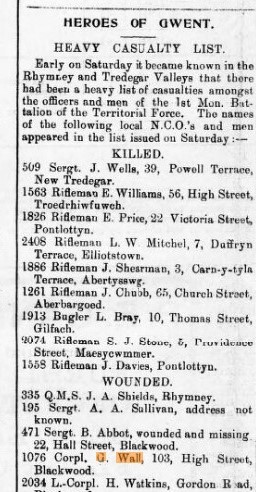
He was initially reported in the local newspapers as just wounded, suggesting that he survived the initial injury. The image below is taken from the Monmouth Guardian on 7 May 1915. Image from The National Library of Wales.
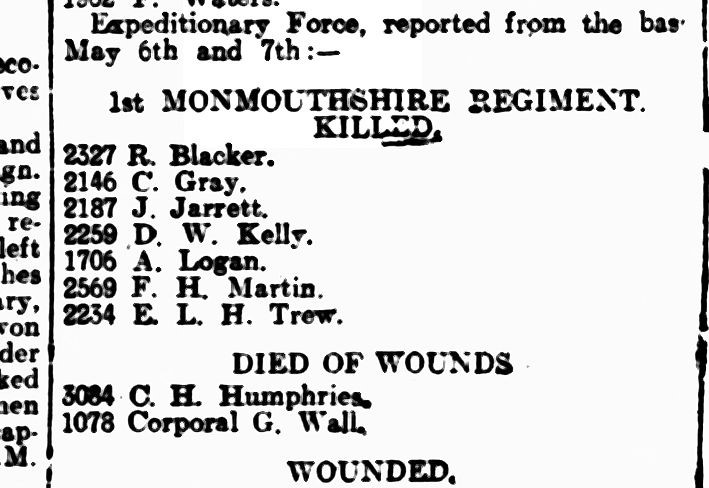
Sadly it was not long before it was confirmed in local papers that George had died from his wounds. Image © Reach PLC. Image created courtesy of THE BRITISH LIBRARY BOARD. Image reproduced with kind permission of The British Newspaper Archive (www.britishnewspaperarchive.co.uk)
His wife Mary Ellen, still a fairly young woman herself, was left with 3 children to raise alone. She remarried in 1921.
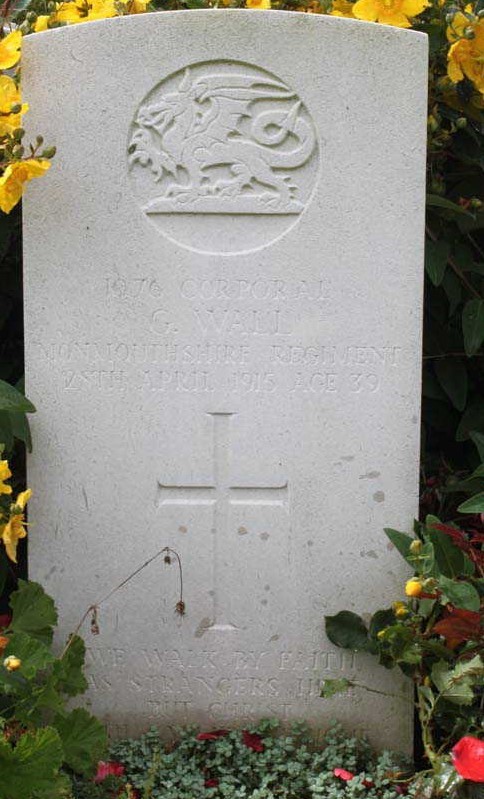
George was buried at the Bailleul Communal Cemetery Extension in Nord, France. He is also commemorated back home on the New Tredegar War Memorial. The image below of the gravestone in France was borrowed from a family tree on ancestry.com.
The final piece of documentation I could find for John Edmund Wright was the Army Register of Soldiers' Effects. This gave one more small detail about his death - that he died at the No. 8 Casualty Clearing Station, again suggesting that he did not die straight away from his wounds. This document showed that at the time of his death he had £7.7s.1d owed him, which along with the £4 standard War Gratuity was paid to his widow Mary Ellen. Not much to show for the ultimate sacrifice, especially when Mary Ellen was left with 3 children to raise. Mary Ellen also received a pension, but probably only until the children were all 16 and she had remarried.
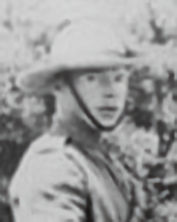
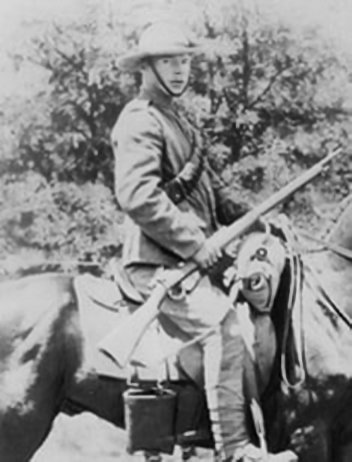
So far I've only found one photo of George. The photo below appears on several websites and seems to have come from his granddaughter Oriel. Unfortunately I have been unable to find her, to confirm it's OK to share it here, but would love to hear from her if she ever sees this. If anyone else has any more photos of George Wall, please do get in touch. E-mail: n.rowberry@btinternet.com
In researching George Wall's final days, several sites have been invaluable, so I've included links to some of them here.
The Commonwealth War Graves Commission:

The National Archives at Kew:

The British Newspaper Archive:

The National Library of Wales:



If any of the above is of further interest, please feel free to contact me at: n.rowberry@btinternet.com
Nicky Rowberry 2024
Thank you for visiting my site. You are visitor number:
Peasants to Puddles - My Family History. By Nicky Rowberry