
Peasants to Puddles
My Family History - By Nicky Rowberry
Arthur Stevenson - Lance Corporal 265876
This page is dedicated to the memory of Arthur Stevenson who died on 26th September 1917.
Arthur Stevenson died on 26th September 1917 in Belgium. He was unfortunately one of the casualties amongst the millions of men who lost their lives in World War 1. It seemed sad for him to have died and all but these bare facts remembered, so I've tried to find out at least a little about his life before his untimely death aged just 31.
Arthur Stevenson was born on 2nd May 1886 at 40 Wycliff Street in Basford, Nottinghamshire. He was the 4th of 9 children of Martin Stevenson and his wife Kate (or Catherine) Shaw. His father Martin was an engine fitter or mechanic. By 1891 the family were still living in Wycliff Street and Arthur was at school aged 5. His maternal grandparents lived next door, which must have been a big help to his mother with 9 children. In 1901 the family were living at 25 Osberton Street, Basford. Martin was now working as a fitter on lace machines and Arthur was now working, aged 14, as a van lad.
Arthur married Ellen (or Nelly as she was known) Webster in 1910. In 1911 the young couple were living 30 Queen Street, Old Basford with their 2 month old daughter Ethel. Arthur was working as a bobbin presser in the lace trade. His parents and younger siblings in 1911 were still living in Osberton Street and his father was described as a lace machine mechanic.
War broke out in the summer of 1914. Unfortunately many of the WW1 service records were destroyed in a bombing raid in WW2 and Arthur's was one of those that didn't survive. So I don't know when exactly he enlisted, but it probably wasn't in the first 2 years since he had a wife and a young child. Arthur's father died in April 1916 and his second child was born in late 1916, but Arthur may have already have enlisted by then. The Commonwealth War Graves Commission website confirms that he was a Lance Corporal in the 2nd/7th Battalion of Sherwood Foresters (also know as the Robin Hoods) and that his service number was 265876. I can't reproduce his CWGC record, but to see his page please click here.
You can now look at the Medal Roll cards from the first world war online. These show a soldier's name, rank and what medals they were entitled to. Due to copyright issues, I don't think I can reproduce the image of the medal card, so instead I've transcribed it:
| Name | Corps | Rank | Regtl No. | ||
| STEVENSON | Notts & Derby R | Pte | 265876 | ||
| Arthur | " | " | " | ||
| Medal. | Roll | Page | Remarks | ||
| VICTORY | F/103B31 | 6222 | |||
| BRITISH | " | " | |||
| 14 STAR | |||||
| Theatre of War first served in | |||||
| Date of entry therein | |||||
His medal card suggests he would have been entitled to 2 medals. The British Medal was awarded to servicemen who served in a theatre of war between 5th August 1914 and 11th November 1918. The Victory Medal (Allied Victory Medal) was awarded for service in any operational theatre over the same time frame. The Star was awarded to all those who served in any theatre of war against Germany between 5th August 1914 and 31st December 1915. He doesn't seem to have been awarded the Star, suggesting he enlisted after 1915, perhaps because he had a young family.
Although Arthur's service records haven't survived, you can now look online at the War Diaries for a given Regiment. War Diaries were kept as a daily record of operations, intelligence reports and anything else that was going on for a given battalion. I do know that the 2/7th battalion arrived in France at the end of February 1917, having previously been stationed in Dublin. I've transcribed the relevant war diary for the day of Arthur's death below. I've also transcribed the few days before - to give a feel of what he must have been doing in his final days.
| 2/7 Sherwood Foresters WAR DIARY FOR September - 1917 | |||
| WAR DIARY or INTELLIGENCE SUMMARY | |||
| Place | Date | Hour | Summary of Events and Information |
| 23rd | Battalion moved to YPRES NORTH area by march route. | ||
| 24th | Battalion relieved 2/6th North Staffs in front line E if WIELTJE | ||
| 25th | Battalion holding front line trenches. | ||
| 25th | Battalion attached on a two Company frontage as per orders attached. All objective gained and maintained in spite of heavy enemy counter attacks (see report of operations attached) | ||
So there was a separate report detailing the events of the days surrounding 26th September 1917, written by the Lieutenant Colonel commanding the 2/7th Sherwood Foresters. I've transcribed the page below.
| By 3.30am on the morning of the 26th the Battalion formed up in 2 waves on 2 Company frontages on lines which had been previously taped under cover of darkness; In the front wave "D" Company on the left and "A" Company on the right, and the rear wave "C" Company on the left and "B" Company on the right. During the night orders were received that ZERO hour would be 5.50. At about 4am a bombardment by our guns was put down on the enemy lines, which apparently proved effective. At this time an enemy barrage was put down on our rear waves, but caused few casualties The Battalion advanced and the barrage was lifted according to time table The first wave suffered a fair number of casualties through Machine Guns at CANSASHOUSE and the strong points round CROSS COTS. The first objective was then consolidated by the first wave, the 2nd wave leapfrogging over, and here direction was slightly lost. A position about D.14. a.5.2 was captured by a Section of the right Company. It was then handed over to the Battalion on the right. From here little opposition was met by the 2nd wave on to their 2nd objective, most of the casualties being through enemy shells. The 2nd objectived was then captured and consolidated. I received a message at 7.15am that the first objective was in our hands at 6.20am At about 7.30am I received another message to say that we had captured and were consolidating the 2nd objective at 7.15am During the morning and early afternoon enemy shelling was not heavy on the front line, but was on the 2nd line and the rear area about SCHULER GALLERIES and CAPRICORN KEEP About 2pm the enemy launched a local counter attack which was broken up by our Artillery Fire. The barrage was apparently brought down by one of our Aeroplanes who spotted the enemy concentration. About 5.30 the enemy put down a creeping barrage apparently on the whole of the front line, and he then launched a heavy counter attach. The troops on the extreme right and left flanks, for some reason unknown, then began to retire. I am not cler as to whether there were any troops in my immediate front or not. None were seen. An SOS Barrage was put down by our own Artillery, and also a heavy barrage by our barrage Machine Guns, both of which seemed to prove effective. In any case, the counter attack stopped before reaching our front line. The nearest enemy did not get to a point nearer than 450 yards. The enemy then shelled the region of our front line and CANSAS HOUSE. By this time stragglers had been collected and the front line reinforced, and the unit holding the 3rd objective were collected and sent up into their original position to reinforce a small body who had apparently still remained in their position. From about 9.30pm there was practically no shelling whatever. |
Neither the war diary nor the more detailed report name any of the other ranks of soldiers who died. There was heavy shelling and machine gun fire, either of which may have been the cause of Arthur's death. The events described above were part of the Battle of Polygon Wood. The Battle of Polygon Wood was in turn part of the wider 3rd Battle of Ypres, also known as the Battle of Passchendaele, one of the bloodiest phases of WW1. The 2/7th Battalion lost so many men, that it was ultimately reduced to cadre and either disbanded or absorbed into another battalion.
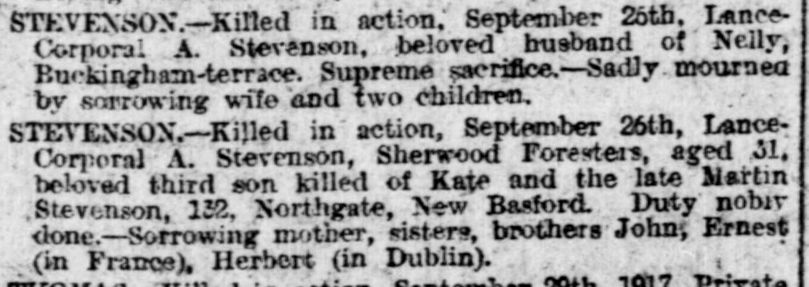
Arthur's death was reported in the local newspapers. The image below is taken from the Nottingham Evening Post on 24th October 1917. Image © Reach PLC. Image created courtesy of THE BRITISH LIBRARY BOARD. Image reproduced with kind permission of The British Newspaper Archive (www.britishnewspaperarchive.co.uk)
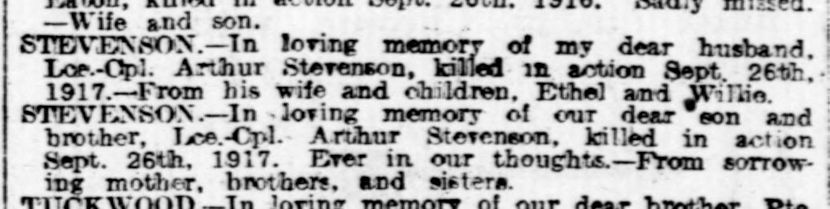
His family also had a notice posted in the local newspapers on the second anniversary of his death. The image below is taken from the Nottingham Evening Post on 26th November 1919. Image © Reach PLC. Image created courtesy of THE BRITISH LIBRARY BOARD. Image reproduced with kind permission of The British Newspaper Archive (www.britishnewspaperarchive.co.uk)
Arthur was buried in the Tyne Cot cemetery in Belgium. He is commemorated on the St Leodegarius Church War Memorial in Basford. 3 of Arthur's brothers were also killed during the war, so his mother lost 4 of her 6 sons. The family also lost 2 of William's cousins; the Stevenson family paid a heavy price in WW1.
The final piece of documentation I could find for Arthur was the Army Register of Soldiers' Effects. This document showed that at the time of his death he had £5.17s.7d plus £14 war gratuity, which his widow Ellen received. Not much to show for the ultimate sacrifice.
I've yet to find a photograph of Arthur. He had a wife and family, so you would hope there would be a photograph out there somewhere. So if anyone has a photo of Arthur Stevenson, please do get in touch. E-mail: n.rowberry@btinternet.com
In researching Arthur's life, several sites have been invaluable, so I've included links to some of them here.
The Commonwealth War Graves Commission:

The National Archives at Kew:

The British Newspaper Archive:




If any of the above is of further interest, please feel free to contact me at: n.rowberry@btinternet.com
Nicky Rowberry 2025
Thank you for visiting my site. You are visitor number:
Peasants to Puddles - My Family History. By Nicky Rowberry