
Peasants to Puddles
My Family History - By Nicky Rowberry
Joseph Samuel Higginson - Private L/13523
This page is dedicated to the memory of Joseph Samuel Higginson who died on 25th April 1915 at Gallipoli.

Joseph Samuel Higginson was born on 20th September 1890, the eldest son of Joseph Everard Higginson and Jane Chamberlain. He died on 25th April 1915 at Gallipoli, one of the many millions of men who lost their lives in World War 1. It seemed sad for him to have died and all but these bare facts remembered, so I've tried to find out at least a little about his life until his untimely death aged just 24.
Joseph's early life was spent first in Shoreditch and then in West Ham, where his father worked at a sawmill. Young Joseph seems to have chosen a career with the army as by the 1911 census, he had already enlisted with the Royal Fusiliers and was stationed in India.
The Commonwealth War Graves Commission website revealed that he was a private in the 2nd Battalion of the Royal Fusiliers Regiment that his service number was L/13523 and that he is commemorated at the Helles Memorial in Turkey. I can't reproduce the CWGC photo of the cemetery, but to see his page please click here
You can now look at the Medal Roll cards from the first world war online. These show a soldier's name, rank and what medals they were entitled to. Due to copyright issues, I don't think I can reproduce the image of the medal card, so instead I've transcribed it:
| Name | Corps | Rank | Regtl No. | |||
| Higginson | 2 R FUS | Pte | L/13523 | |||
| Joseph S | - | - | ||||
| Medal. | Roll | Page | Remarks | |||
| VICTORY | L/TP/104 B5 | 427 | K in A 25/4/15 | |||
| BRITISH | ditto | ditto | ||||
| 15 | STAR | TP/63 B | 47 | |||
| Theatre of War first served in | 2B/Balkans | |||||
| Date of entry therein | 25.4.15 | E7/9/3672 E/95323/2 | ||||
And on the back it says:
| Correspondence | |
| OI/C Infy Recs London, Subts Nom Roll of indiv: for whom No. E7118A has been received 10/8/20 | |
| Address. | Father Mr J.E. Higginson |
| 19B Tavistock Square. | 52 Lockhurst St. |
| W.C.6. 20/8/20 | Clapton Park E.S 20/9 |
As is so often the case with these medal cards, not all of the information has been filled in, but it does indicate that he would have been entitled to three medals. The British Medal was awarded to servicemen who served in a theatre of war between 5th August 1914 and 11th November 1918. The Victory Medal (Allied Victory Medal) was awarded for service in any operational theatre over the same time frame. The 1914-1915 Star Medal was issued to all those who served in any theatre of war against Germany between August 1914 and 31st December 1915. Apparently these three war medals are known by the nicknames of Pip, Squeak and Wilfred! Many of the British Army World War One Service Records were destroyed when the War Office in London was bombed in 1940 and unfortunately Joseph's seem to have been among those lost. So I've got no further detail about Joseph's personal involvement in the war.
The Gallipoli campaign itself is of course well documented, so some insight can be gleaned into his final days. At the outbreak of WW1, the 2nd Battalion were stationed in India (since Joseph was already in the army at the outbreak of the war, it is reasonable to assume he too was in India). Within months though they were back in England and joined the 29th Division, training to go to France. By March 1915 orders arrived for them to head to Gallipoli, which they did via Malta and then Alexandria. The War Diaries for the 2nd Battalion Royal Fusiliers have just become available online. The War Diaries were kept as a daily record of operations, intelligence reports and anything else that was going on for a given battalion. I have transcribed the relevant diary for the month before the assault at Gallipoli to try and get an insight into Joseph's final days. This section of the diary starts with the regiment stationed at the MEX camp near Alexandria. They were then taken by boat to the island of Lemnos in the north Aegean Sea in readiness for the attack at Gallipoli. Unfortunately there does seem to be a gap in the diaries available online for the 22nd to 24th April - important days just before the attack. (I hope to be able to track down the missing pages on my next trip to the National Archives at Kew.) The diaries then describe in fair detail the landings and initial assaults against the Turks.
M.E.Force War Diary 2nd Battalion Royal Fusiliers From 30.3.15 To 12.5.15 | |||
| WAR DIARY or INTELLIGENCE SUMMARY | |||
| Place | Date | Hour | Summary of Events and Information |
| MEX Comp | Mar 30th | Battalion Parade in the morning. The transport officer and 60 other ranks (including 12 A.S.C) reached camp about 8pm with the transport animals. | |
| MEX Comp | Mar 31st | Bathing parade early morning. Later Route march. | |
| MEX Comp | April 1st | Battalion manoeuvres parade. Practice disembarkation and taking up of covering positions. | |
| MEX Comp | April 2nd Good Friday | Battalion parade 7.45am. Embarkation and subsequent disembarkation from Boats practised on a beach near Adami Fort. Church Parade 6.30pm. 2 men admitted to Hospital | |
| MEX Comp | April 3rd | Practice of disembarkation under fire followed by an attack. | |
| MEX Comp | April 4th | Easter Sunday. ??? Service | |
| MEX Comp | April 5th | Company arrangements. Bathing. W company practices landing by night | |
| MEX Comp | April 6th | Brigade inspected by Gen. Sir Ian Hamilton. X Company practised landing by night | |
| MEX Comp | April 7th | Company at disposal of ? Commander. Orders received to be prepared to embark the following day. | |
| MEX Comp | April 8th | Orders received to embark on SS Alaunia less any waggons | |
| WAR DIARY or INTELLIGENCE SUMMARY | |||
| Place | Date | Hour | Summary of Events and Information |
| MEX Comp | April 8th | Battalion struck camp after breakfast and carried all stores etc. to Rail Head Med Terminus where they were packed in trucks by 11am. Y Company left with the other team at 12 midday & unloaded it at the wharf, Alexandria Docks. The battalion marched to the Docks and embarked on the Alaunia at 3pm. The 1st ??? transferred waggons belonging to the Lancashire Fusiliers and our own were taken off the ship, and she was then loaded the Regt Stores. No horses or carts were put on the boat. The strenght of the battalion embarking was officers 25 and our M.O. and 948 Other Ranks. One officer and 48 other ranks (Transport) embarked on the SS Marquette.
Troops on board the SS Alaunia 2nd Battalion Royal Fusiliers, 2nd Battalion South Wales Borderers, Detachment R.E., & Detachment Royal Naval Reserve. | |
| SS Alaunia | April 9th | Left Alexandria Docks at 10am & steamed straight out to sea. Destination unknown. |
|
| WAR DIARY or INTELLIGENCE SUMMARY | |||
| Place | Date | Hour | Summary of Events and Information |
| At Sea | April 10th | Physical Drill. Ordinary Routine | |
| At Sea | April 11th | ???? Service. Arrived at Lemnos & tied up alongside the City of Edinburgh. A good number of troppships including Australians, & a number battleships were already in the habour. |
|
| Lemnos | April 12th | Boat drill & ladder drill. |
|
| Lemnos | April 13th | Moved from City of Edinburgh & tie up alongside the Andania. Physical Drill |
|
| Lemnos | April 14th | Typical drill & rowing practiced. |
|
| Lemnos | April 15th | Typical drill & rowing practiced. |
|
| Lemnos | April 16th | Physical drill & rowing practiced. Great difficulty was experienced daily in getting boats for practice. The ships crew refused on one occasion to lower the boats & as they appeared to be neither under Military nor Naval Law it was difficult to deal with them. |
|
| Lemnos | April 17th | W. X. Y. Companies & Machine Gun Section were landed |
|
| WAR DIARY or INTELLIGENCE SUMMARY | |||
| Place | Date | Hour | Summary of Events and Information |
| Lemnos | April 17th | on the island in the morning in tows of eight boats & during the afternoon they re-embarked and returned to the ship in tows of six cutters. HMS Implacable towed the Companies ashore | |
| Lemnos | April 18th | W & X Companies & M.G Sections went on board HMS Implacable and practiced getting into cutters from ladders. |
|
| Lemnos | April 19th | Physical training & boat practice. Z Company were rowed ashore in the morning where they landed & returned in the afternoon. |
|
| Lemnos | April 20th | Physical training & boat practice. A strong North wind sprung up during the day. |
|
| Lemnos | April 21st | The G.O.C Division held a Conference of Brigadiers & C.O.s. during the morning. |
|
| WAR DIARY or INTELLIGENCE SUMMARY | |||
| Place | Date | Hour | Summary of Events and Information |
| Gallipoli Peninsula | April 25th | 3 AM | Arrival off Gallipoli at about 3AM - "W" & "X" Coys & Machine Guns disembarked from HMS Implacable into cutters (Tows of 4) at 4am. General Bombardment by the battleships took place. |
| 5.15AM | The Implacable steamed in towards "X" beach with 2 tows on either side & the two fleet sweepers containing "Y" & "Z" Coys on the Port Side - The Implacable covered our landing with every available gun & except for distant rifle fire there was no opposition to our landing & we suffered no casualties. "W" & "X" Coys scaled the cliff and took the top without any immediate opposition - meanwhile "X" & "Z" Coys were landed with ammunition & tools. The two former coys were sent out right and left to attack Hill 114 and enemy trenches on our left. They were met by heavy fire & suffered many casualties - "Z" Coy on arrival supported "W" Coy and took Hill 114 at point of Bayonet by 11am with 42 prisoners. X Coy was ordered from the top of the cliff to our front & left for about 300x. Y Coy supported them - a little opposition was encountered but the enemy retired about 9am - on the left the enemys first line of trenches |
||
| WAR DIARY or INTELLIGENCE SUMMARY | |||
| Place | Date | Hour | Summary of Events and Information |
| Gallipoli Peninsula | was occupied, but at the second line they were met by considerable opposition & compelled unavoidably to withdraw before a superior force & suffered severely - The Borders Regt which had just landed at "X" beach eventually came to their assistance & for the rest of the day they were attached to the Borders Regt & eventually entrenched themselves for the night south of ridge 200. "W" & "Z" Coys after taking Hill 114 reformed & advanced North East & East & met with opposition on the reverse slope of hill from the enemy who were entrenched there. They were dislodged by 2pm & their position was entrenched & held for the night. The enemys next position was 700x yards to their front. | ||
| Night 25-26 | During the night of the 25-26 our line was attacked & the enemy appeared at the time to be about 150x from our trenches in considerable force - Heavy fire was maintained throughout the night but at dawn the enemy had withdrawn to their old line. |
||
| 26th | Whole line taken up the previous night was the same. At 10am information was received that the French were expected to land & reinforce us with 6 Battalions. Also that our left must be strengthened as much as possible & expect an attack from the North. |
||
| 26th | 2pm | Our line was attacked - enemys strength 1500. but were driven back with heko of artillery fire. Our M.Gs did good work & heavy rifle fire was kept up during the ???. About 1/2 hour later the enemy were reinforced by another 1000 who came forward here to our right front but were driven back. |
|
| 26th | 5.30pm | Hill 141 about 1800x to our right front was captured & the enemy could be seen returning towards Achi Baba. Several prisoners were taken on the right & no attack was made that night by enemy. |
|
The diaries suggest that in the month leading up to the attack, the days were filled with practice drills and routine training. The men would probably not be used to beach landings or even rowing, so much practice went into these basics. We will probably never know for sure how poor Joseph died, but the diaries indicate heavy losses were suffered at the attempt to capture Hill 114 under heavy fire, so perhaps this was when Joseph was killed.
Gallipoli was a key strategic point between the Black Sea and the Aegean Sea. The 2nd Battalion sailed on HMS Implacable and were put ashore on what was known as "X" Beach at Gallipoli on 25th April 1915, with the battleship providing covering fire for them. X beach was one of 5 beaches on the peninsula landed by the allies that day. Although the beach itself was successfully taken, the overall Gallipoli Campaign was a failure and cost many allied lives, including of course Joseph Higginson's.

111 men of the 2nd Battalion Royal Fusiliers are listed as having died at Gallipoli on the same day as Joseph. Of these, at least 9 were listed with him in the 1911 census, suggesting that they would have been together for some time. I don't know at what point Joseph died, but he probably saw men he'd known and friends struck down around him, before he was hit too.
The Gallipoli or Dardanelles Campaign was of course widely reported in the newspapers of the time. The British probably played down the failure that the campaign ultimately was, in order to maintain morale. This article from a newspaper two days after Joseph's death gives an idea of how things were being reported. Image © Trinity Mirror. Image created courtesy of THE BRITISH LIBRARY BOARD. Image reproduced with kind permission of The British Newspaper Archive (www.britishnewspaperarchive.co.uk) Click: www.britishnewspaperarchive.co.uk to see the full newspaper page.

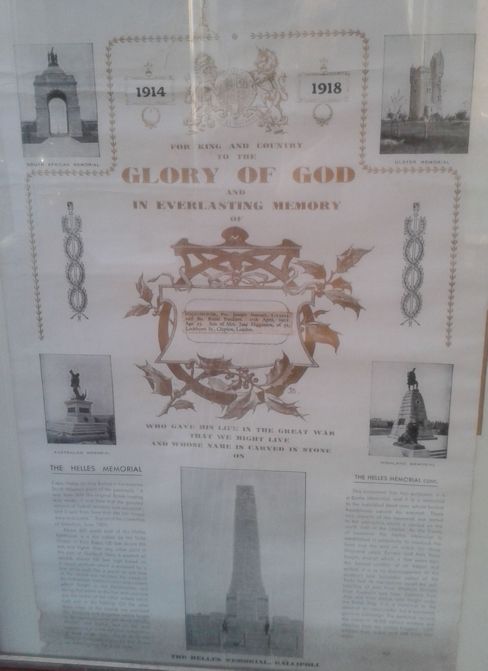
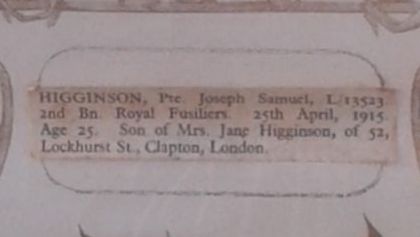
Families of soldiers who died in the war were issued with a memorial scroll to commemorate their sacrifice. The photos below show the memorial scroll (with a close up) for Joseph that has remained in the family to this day and was kindly shared with me by his niece Doreen.
 |  |
The final documentation of Joseph's life is the Army Register of Soldier's Effects. These registers show what monies were owing to the soldier at the time of his death - in the case of Joseph it amounted to £10.14s.3d, plus the War Gratuity of £5. This money was allocated to his parents Joseph & Jane. By any standard it doesn't seem much for their son's life.
In researching Joseph's final days, several sites have been invaluable, so I've included links to some of them here.
The Commonwealth War Graves Commission is a great site to start with to give you the basic details you would need to then start digging deeper:

The National Archives at Kew now hold a huge number of records, many of which are available online, but it is well worth a visit down there if you can make it:

The British Newspaper Archive holds digitised images of newspapers from all over Britain. New pages are added weekly and it can be a great way of adding to your research:


If any of the above is of further interest, please feel free to contact me at: n.rowberry@btinternet.com
© Nicky Rowberry 2015
Thank you for visiting my site. You are visitor number:
Peasants to Puddles - My Family History. By Nicky Rowberry